When excitement around The Devil Wears Prada 2 began building this past spring, shoppers immediately began searching for related fashion trends online. Algolia’s search and discovery platform saw searches for “cerulean” spike the same week Old Navy and Target announced Devil Wears Prada-inspired collections, while searches related to the movie surged more than 70% week-over-week during the premiere buzz.
The behavior highlights a larger shift happening across ecommerce: consumers increasingly expect shopping experiences to move at the speed of culture, and that’s only possible with AI.
Algolia surveyed 1,000 U.S. adults to understand how consumers see AI fitting into their shopping decisions, from search and discovery to fashion inspiration to keeping up with pop culture, and found 61% of consumers say wider AI adoption will create better shopping experiences.
The findings are clear: consumers want AI to make shopping easier and more personalized, especially when it comes to keeping up with the latest pop culture trends.
AI may run ecommerce, but Meryl Streep still drives search traffic
AI may influence how consumers search, but culture still shapes what consumers actually want. Especially Gen Z. Sixty-three percent (63%) of Gen Z say pop culture influences their purchases and 61% of the generation have purchased an exact item after seeing it in pop culture.
Forty-six percent (46%) of consumers have researched similar styles after seeing something in movies, TV, concerts, or celebrity culture and 47% saved items for future inspiration after seeing pop culture trends. The inspiration extends to online mediums as well, with 39% saying social media influences their fashion purchases the most.
The moment a trend emerges in entertainment, social media or celebrity culture, shoppers immediately begin searching for related styles, aesthetics, colors, and products online. Retailers that can quickly connect emerging cultural moments to relevant product discovery experiences will have a significant advantage.
But keeping pace with culture at internet speed is impossible manually. That’s where AI-powered search becomes strategically important to understand intent behind vague or conversational queries, surface trend-adjacent products, and recognize emerging keywords in real time before they become mainstream.
Retailers need AI that understands vibes, not just keywords
As culture-driven shopping accelerates, consumers are also changing the way they search. Consumers increasingly expect ecommerce to feel intuitive and personalized. Sixty-two percent (62%) of consumers expect online search bars to understand natural language like ChatGPT and 34% already use conversational language when searching on retailer websites. The expectations increase for younger generations. Almost half (48%) of Gen Z already search this way and 75% of Gen Z expect retailers to have natural-language search capabilities.
Retailers now have competition aside from themselves as consumers now stack their experiences up against ChatGPT, TikTok, and AI assistants.
Consumers are clearly becoming more comfortable using AI during the shopping journey. But there’s a major difference between AI helping consumers discover products and AI making decisions on their behalf.
The future of shopping is AI-powered and human-curated
While consumer comfort with these tools is accelerating, hesitation rises sharply when AI begins acting autonomously. That tension becomes especially visible when retailers begin introducing more autonomous AI shopping experiences.
Target recently updated its terms and conditions to say that shoppers are ultimately responsible for any errors, inaccuracies, or issues that occur if they use the retailer’s AI assistant to search for items or complete their orders. We asked consumers how the announcement impacted their trust in AI shopping assistants:
-
Thirty-two percent (32%) said it made them less likely to use the Target AI shopping assistant.
-
Twenty percent (20%) say those types of announcements erode their trust in AI shopping as a whole. Among Gen Z, concern was even higher with 31% saying the same.
-
Twenty percent (20%) say if the responsibility is on them for mistakes, they won’t be using AI shopping assistants at all.
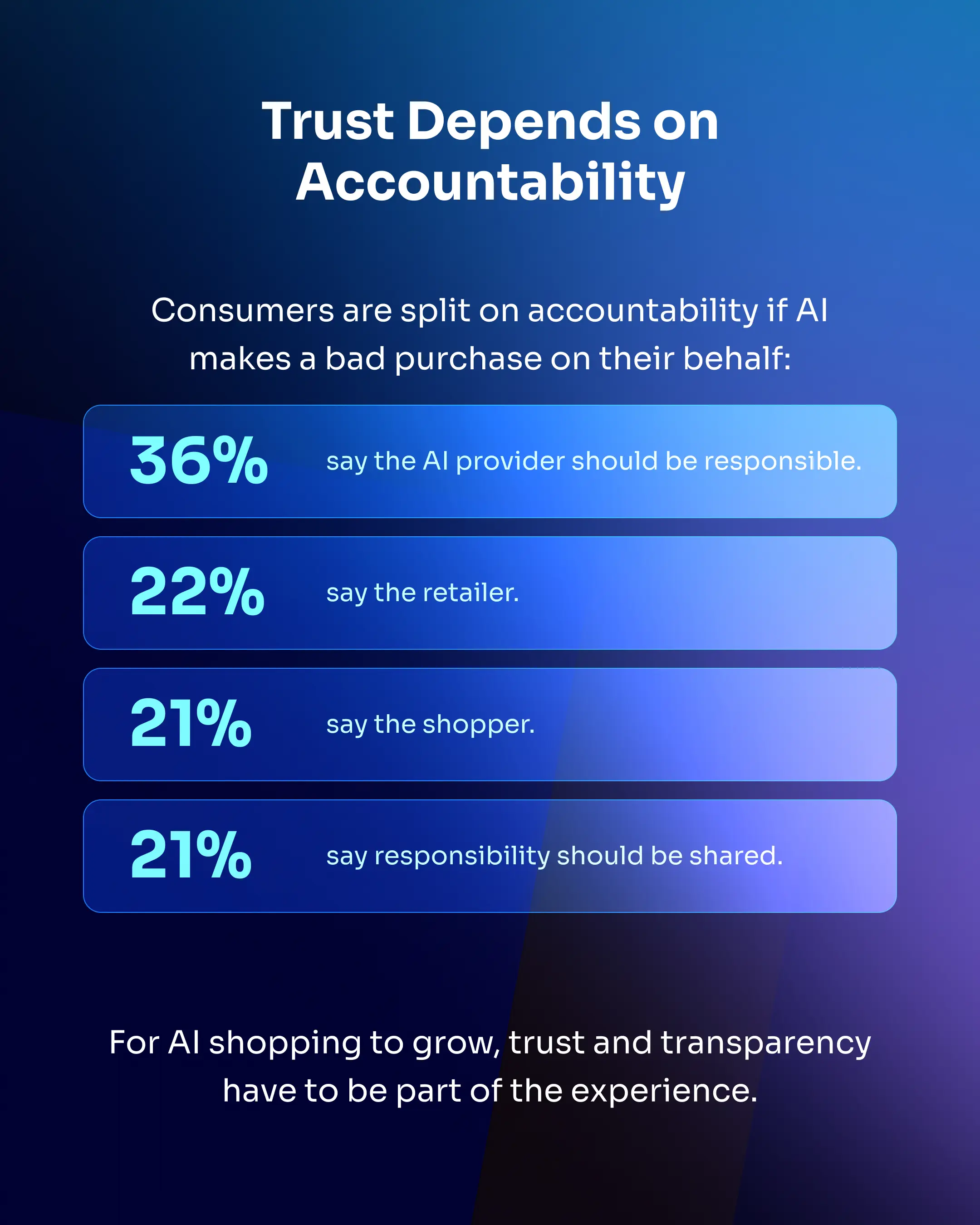
When asked who should be responsible if AI makes a bad purchase on your behalf, the responses were mixed:
Trust breaks down when accountability becomes unclear. More than half of consumers (54%) said they wouldn’t trust AI to make purchases without review, including 80% of baby boomers compared to just 38% of Gen Z. Even among those open to AI-led purchases, comfort levels skew toward low-cost items: 20% would trust AI to buy products under $50 without review, while only 8% would trust it with purchases over $250. Consumers are increasingly comfortable with AI assisting purchases, but far less willing to give up oversight on higher-stakes decisions.
The new rules of retail: AI drives discovery, culture drives demand
Retailers have an opportunity to use AI to improve discovery and personalization, but only if they preserve transparency, trust, and human-centered experiences.
We recommend to:
-
Design AI experiences that enhance customer confidence rather than remove customer control
-
Prioritize conversational and intent-driven search experiences
-
Maintain transparency around recommendations and data usage
-
Preserve human curation, merchandising, and brand identity within AI-powered experiences
-
Use AI to enhance inspiration and discovery rather than fully automate decisions
Consumers may use AI to search for “cerulean sweaters,” discover similar styles, or compare products faster than ever before. But the reason they wanted the sweater in the first place still came from pop culture and human influence.
Retailers need to leverage AI to keep up with what’s trending while still maintaining emotionally intelligent, curated, and consumer-controlled shopping experiences. For retailers looking to keep up with the zeitgeist, partnering with Algolia to power agentic, generative, and search experiences is the next step.










 Other Types

%20(2).svg)